


Photo Courtesy of Giuseppa Nadrowski.
Growing up, I spent many summers at my grandfather’s Christmas tree farm in South Boardman, a small town in Kalkaska County. It’s an area that’s not only special to me, but also to my husband and two children — so much so that we spend as much of our free time as possible exploring the area’s many scenic treasures.
On the search for a nearby, family- friendly hike, we recently discovered Seven Bridges Natural Area — a 314-acre preserve in Rapid River Township north of Kalkaska that features a mix of upland habitat, mesic northern forest, cedar swamps, rustic wooden bridges (only four remain now), peaceful paths, and about a mile of the gorgeous Rapid River.
The hike seemed perfect. It wasn’t far off U.S. 131; it was easy enough for our growing kids (now 13 and 11), and exactly the adventure we were looking to take after a hearty breakfast at the locally adored diner, Moose & Stella’s Café.

Protected and maintained by the Grand Traverse Regional Land Conservancy (GTRLC), Seven Bridges was purchased by the State of Michigan in 1998. Its story began in 1882, when four German brothers — Jacob, Julius, William, and Carl Ricker — built a sawmill on the site.
Eventually the mill was passed down to their great-nephew, Gordon Peschke, and his siblings. Peschke and his wife, Cecilia, deeply cared for the land and, realizing its beauty and value, encouraged the public to use it (they even kept a guestbook for visitors to sign). It became a beloved spot where locals and visitors alike enjoyed fishing, hiking, and picnicking.
By the mid 1980s, there was pressure from Peschke’s siblings to sell the land. In 1989, after a failed attempt to find a conservation group to purchase it, the land was sold to a development partnership that planned to split the property into 10-acre luxury parcels. Then, thanks to a valiant, multiyear effort by the GTRLC, the State was convinced to purchase the property — with the stipulation that it would continue to care for the site.
This visionary undertaking has allowed future generations to marvel at the park’s beauty, all while protecting the local forestry and wildlife — and even the area’s water quality.
“The braided stream that works its way through the various wetlands really allows the water to slow down and take its time, which allows pollution and nutrients to get filtered out before it moves on downstream and eventually makes its way into Lake Michigan,” says Chris Garrock, director of stewardship at the GTRLC. “Once they visit, I think most people realize the tragedy that would (come from) developing a place like that.”

Courtesy of Giuseppa Nadrowski.
Jamie Creason, the owner and innkeeper of the Applesauce Inn in Bellaire, says Seven Bridges is a destination she recommends to all her guests. Creason and her husband, Gary Juliano, a landscape painter, frequent the park often. This past summer, Juliano began taking fellow artists to the park for a plein air painting experience. “We enjoy the quiet that it offers, the little hidden secret trails, and, of course, the beauty of the Rapid River,” Creason says.
Fine art travel and nature photographer Julie Chapa agrees: “I grew up in Fife Lake, not far from this park, and was surprised to only recently discover it,” she says. While Chapa now lives in Texas, she often visits the area. “It’s just a short walk to reach the streams and rapids, where a boardwalk and a couple of benches invite you to pause and take it all in. What I love most is the immersive experience — the soothing sounds of flowing tributaries, the fresh scent of cedar and hemlock, and the feeling of being completely enveloped by the forest.”
Upon entering the preserve, hikers will see the first of four bridges. Beneath, a cascading waterfall captivates, as a does an historic stone wall — a remnant of bygone logging days. It’s a painterly scene that seems torn from the pages of a storybook. “If only the old stone wall could tell its story,” Creason says.
Not far ahead, there’s a second bridge with a tranquil brook below, where the water filters through mosses and stones. As my youngest said, “It’s as clear as day! You can see all the way to the bottom!”
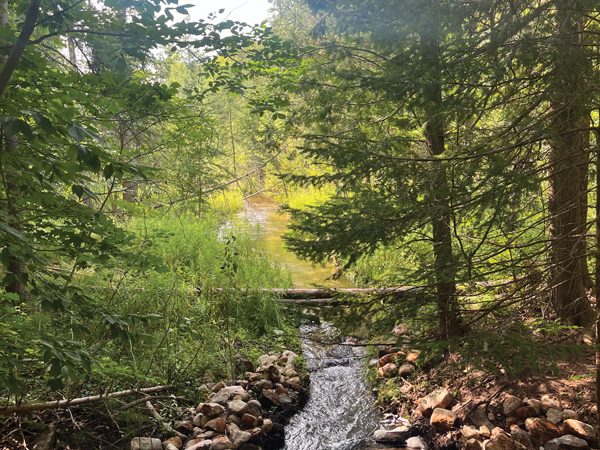
Nature lovers can continue on to the remaining bridges, traverse the many offshoot trails (generally suitable for most ages), revel in the park’s unfiltered beauty (it’s especially enchanting in autumn, as the freshly fallen leaves seem to dance among the landscape), and discover the preserve’s many other treasures. My children look forward to visiting a particular tree every time we hike there; its branches have grown in such a way that a natural seat was created, offering a perfect perch for resting.
The trail, only about a mile in length, loops back into the woods through a serene pasture. “I think it’s a really accessible spot to do a shorter hike that’s not strenuous,” says Garrock, who mentions the park is also a popular place for trout fishing.
“Northern Michigan can be summed up by this preserve,” Creason proclaims. Adds Chapa: “It feels like stepping into a nature documentary. This park is truly a photographer’s dream.” 
PLAN IT!
Seven Bridges Natural Area
gtrlc.org (search under Get Outside)